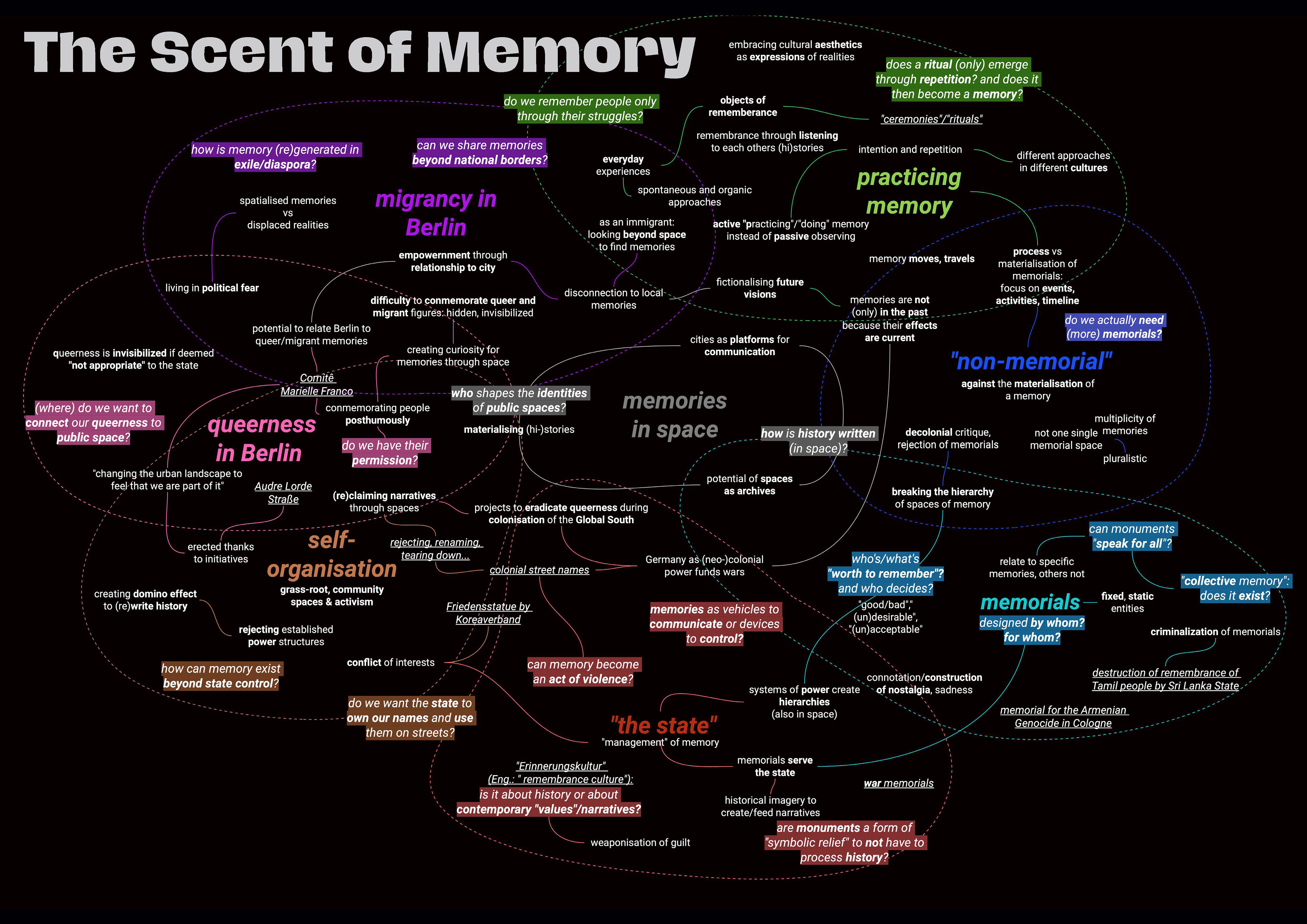
Documentation Mind Map by Pepe Sánchez-Molero and Ana Bisbicus
Workshop: “The scent of memory (our own and that of strangers)’’
Everyday experiences like scents, sounds, and images can evoke memories. In the diaspora, they connect us fleetingly yet intensely to geographically distant places, including those that may no longer exist. In the queer diaspora, this uprooting—also known as dislocation—occurs on multiple levels, not only in relation to one’s place of origin but also in connection to kinship, family, culture, and history. This dislocation is painful, yet it offers the possibility of developing knowledge and practices that help us navigate this potential sense of rupture.
Individual and collective memories create spaces in the city that challenge existing dominant power structures. These memories can manifest spatially, such as through monuments, street signs, or archives that honor individuals or acts of resistance. However, they can also take shape through intangible cultural practices or rituals. Here, memory can become a form of urban practice and city-making. Still, we recognize how fragile these spaces are, even once they have been established. What and how we remember is shaped by limited notions of identity, belonging, and selective memory cultures. Memory spaces are far more than just erected monuments in the city—how can we expand our understanding of them? What role does memory play in the production of queer diasporic spaces? How can tensions, conflicts, as well as the impermanence and fragility of these spaces be negotiated, even after they have been created?
Workshop Day on Queer Diasporic Memories in the City
The Workshop Day on November 16, 2024, at Refugio Berlin united collectives, initiatives, and individuals to participate in a half-day session to reflect on queer diasporic memory in the city, as well as to gather, share, and comment on existing, emerging, and disappearing practices and spaces in Berlin. It also provided an opportunity to make connections, to network with collectives and individuals, and to build alliances. Two parallel sessions were held, led by Sinthujan Varatharajah (essayist and political geographer), and Uriara Maciel (from Comitê Marielle Franco Berlin).
Following both workshops, there was a final joint session in which everyone had the opportunity to reflect on their shared experiences during the sessions, first in small groups and then in a larger collective discussion. The thoughts and open questions shared during this conversation were gathered and documented on-site. These materials, together with the inputs provided by the facilitators during the workshops, were used to create the presented mind map.
The participants mostly attended the workshop as individuals, with a few exceptions representing local queer/migrant initiatives. Everyone connected personally to queerness and migration in their own way, and represented different intersections in terms of age and positionality; many also had a professional connection to spatial practices. The final session was facilitated by Pepe Sánchez-Molero and Ana Bisbicus–and documented though the mind map, while the entire workshop day was moderated by Sharmila Sharma. Awareness was provided by the collective Roses of Care (R.O.C.).
The workshop was conducted as part of the project "Netzwerkstelle Urbane Praxis" 2024, funded by the Senate of Urban Development, Building and Housing.
Host: Urbane Praxis e.V. Berlin
Curation: Ana Bisbicus
Space: Refugio Berlin
Facilitators:
Sinthujan Varatharajah
Uriara Maciel
Moderation: Sharmila Sharma
Documentation & mind map: Pepe Sánchez-Molero and Ana Bisbicus
Logistics/Orga: Kristin Lazarova, Miriam Rausch, Christian Haid
Awareness: Roses of Care
Curation: Ana Bisbicus
Space: Refugio Berlin
Facilitators:
Sinthujan Varatharajah
Uriara Maciel
Moderation: Sharmila Sharma
Documentation & mind map: Pepe Sánchez-Molero and Ana Bisbicus
Logistics/Orga: Kristin Lazarova, Miriam Rausch, Christian Haid
Awareness: Roses of Care